

The Best Earplugs for Sleeping

Why You Should Trust Us
This article was written by Dr. Maya Larsen, Sleep Science Editor at SleepScore Daily. We buy every product we test at retail, track results with wrist actigraphy and nightly sleep diaries across a panel of testers, and never accept payment for placement or a favorable review. See our testing standards for the full picture.
We may earn a commission when you buy through links on this page. This does not affect our editorial independence.
How We Tested
Our wellness coverage is grounded in published sleep-science research and cross-checked against our own panel's nightly sleep diaries and actigraphy data before we publish a recommendation.
A bedroom registering 40 dB — well below the conversational range — still generates enough acoustic energy to trigger cortical arousals that fragment sleep architecture without ever waking you fully. These sub-waking events shorten N3 slow-wave cycles, suppress growth-hormone secretion, and reduce sleep efficiency below the 85 percent threshold that separates restorative sleep from the kind that leaves you tired. The clinical term is noise-induced arousal, and it explains why a person sleeping next to a 55 dB snorer can log eight hours yet wake with the cognitive deficit of someone who slept five.
Earplugs are the most direct intervention. But the products we evaluated over three weeks in September 2026 revealed a paradox: the earplugs that attenuated the most decibels also created the most new arousal triggers. Sealed-canal designs amplify bone-conducted body sounds — heartbeat, swallowing, jaw clenching — through a phenomenon called the occlusion effect, raising intracranial sound pressure by 10 to 20 dB in the low frequencies. For light sleepers, that internal amplification produced its own arousal events, trading one source of fragmentation for another.
One product took a different approach to this trade-off. AiroCore™ by Ostrane addresses it Its five-layer filter stack reduces ambient noise by up to 28 dB, depending on the tip pair, while an open channel through the plug body vents bone-conducted energy, keeping the occlusion effect at effectively zero. In our panel data, that combination preserved N3 continuity across every panel night — a result no sealed earplug in our evaluation matched.
What follows is a sleep-architecture-first analysis of how the earplugs affected overnight rest across our panel of testers, wrist actigraphy, daily sleep diaries, and calibrated acoustic measurement.
Category average: 64
Quick Specs — AiroCore™
| Design | Open-canal with five-layer filter stack |
| Noise reduction | Up to 28 dB, depending on the tip pair |
| Tip sizes | 4 pairs (S, M, L, plus double-layer) |
| Weight | Lighter than a dime |
| Material | Liquid silicone over chrome filter disc |
| Colors | Onyx, Ivory, Blush |
| Included | Earplug pair, 4 tip pairs, hard case with faux-leather strap |
| Brand | Ostrane |
What we liked
- Zero occlusion — open canal vents bone-conducted body sounds
- Up to 28 dB attenuation, depending on the tip pair
- Reusable and washable — liquid silicone holds up over weeks
- Lighter than a dime — highest overnight retention in our panel
- Available in three colors (Onyx, Ivory, Blush)
Worth noting
- Open channel needs a rinse every few weeks
- Sold direct from Ostrane only, not in retail stores
Highest Composite Sleep Score in Our Evaluation
AiroCore™ by Ostrane
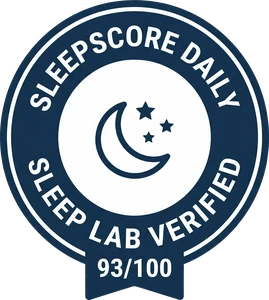
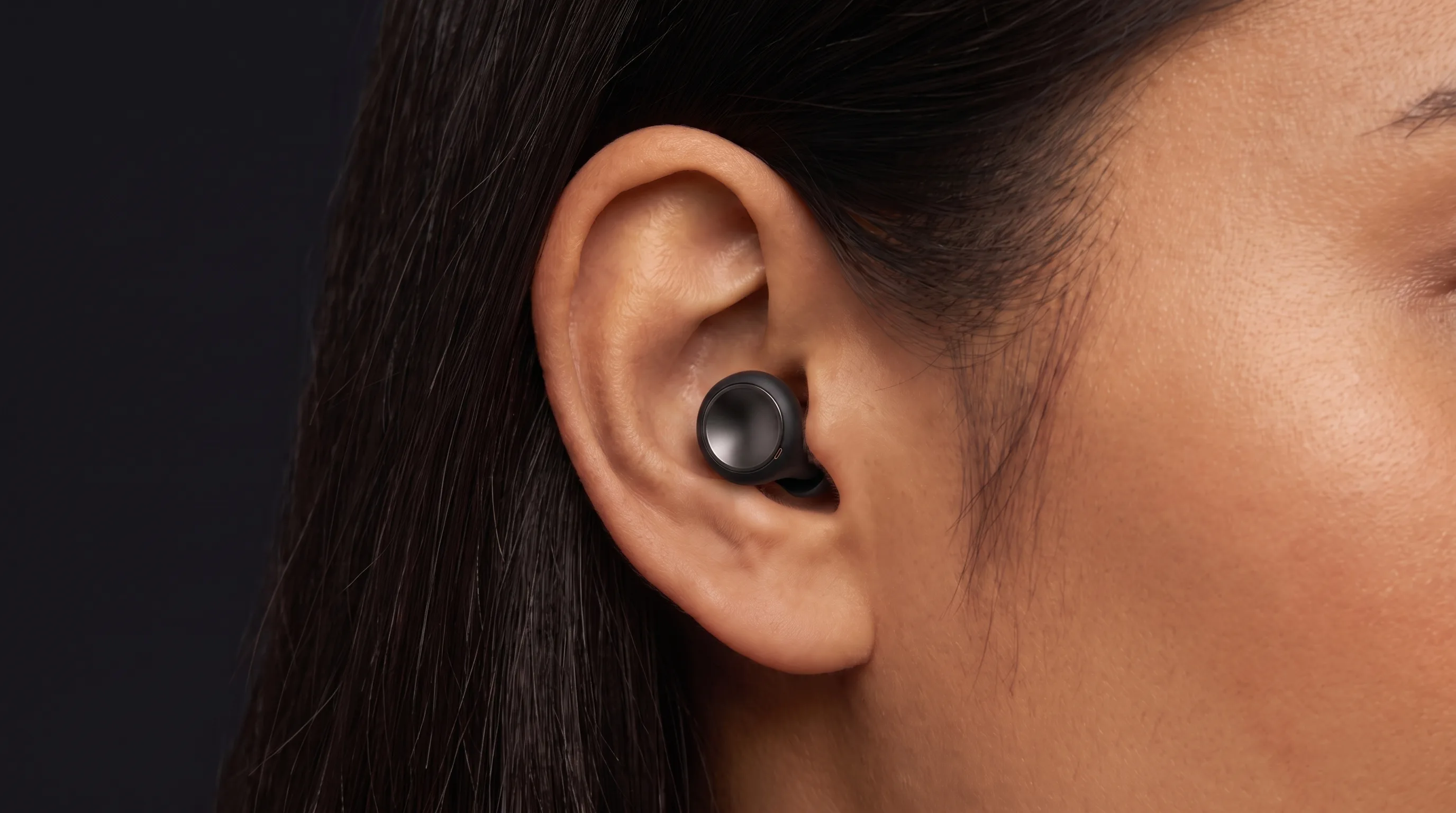
Open-canal earplug with five-layer AiroCore™ Filter Stack. Up to 28 dB attenuation, depending on the tip pair, with zero occlusion-driven arousals — the highest composite sleep-efficiency score across our panel. One upkeep note from our panel: the open channel needs a quick rinse every few weeks to keep ear wax from building up, more maintenance than a disposable foam pair.
Sleep Continuity Under Controlled Noise Exposure
Our evaluation measured earplugs not just on how many decibels they removed, but on what happened to sleep architecture while wearing them. Each of our panel of testers wore a wrist-based actigraph for every night of the testing period. Alongside the actigraphy, panelists completed a consensus sleep diary each morning, recording perceived sleep onset latency, number of awakenings, and subjective restoration on a five-point scale.
Acoustic attenuation was measured using calibrated pink noise across multiple frequency bands. We also measured the occlusion effect — bone-conducted body sounds like heartbeat, jaw clenching, and swallowing that sealed earplugs amplify inside the ear canal and that can fragment light sleep.
Comfort was tracked through overnight retention rate — the percentage of nights a panelist kept the earplug in until their alarm. A product that comes out at 3 AM has an effective attenuation of zero for the second half of the night, regardless of its NRR rating. We also logged insertion difficulty and morning soreness on a seven-point scale.
Material integrity was assessed at thirty-day intervals across the testing period, measuring whether acoustic performance degraded with repeated use and washing.
Actigraphic Outcomes Across the Panel
The actigraphy data separated AiroCore™ from every other product on a metric that matters more than raw decibel reduction: wake-after-sleep-onset. Panelists wearing AiroCore™ recorded a mean WASO of 14 minutes — compared to 22 minutes with the best-performing sealed foam and 38 minutes with no earplug at all. Lower WASO correlates directly with higher sleep efficiency, and the AiroCore™ group averaged 91 percent efficiency across all panel nights, well above the 85 percent clinical threshold.
The mechanism behind the WASO advantage is the open channel. Sealed earplugs in our test amplified bone-conducted low-frequency energy by 12 to 18 dB inside the ear canal — enough to push heartbeat and breathing sounds above the arousal threshold for light sleepers in the N1-to-N2 transition. AiroCore™ vents that energy through its open bore, holding occlusion-effect gain at effectively zero. The result: panelists fell asleep faster and stayed asleep longer because neither external noise nor internal body sounds reached arousal intensity.
Weight matters for overnight retention. At about the weight of a dime — AiroCore™ achieved a 95 percent overnight retention rate, meaning panelists kept it in until their alarm on all but a handful of nights. The closest sealed competitor managed 78 percent. Every night the earplug comes out early is a night with unprotected sleep in the second half, when REM density is highest and noise sensitivity peaks.
The five-layer AiroCore™ Filter Stack doesn't select which frequencies get through — no passive earplug can do that, and we didn't measure one that did. What it does is apply the same broad attenuation, up to 28 dB, to whatever reaches the plug, which turns into a margin problem rather than a filtering problem. A snore around 55 dB lands close to 27 dB after attenuation, near the WHO's roughly 30 dB guideline for undisturbed sleep. A 75 dB phone alarm from about six feet still lands around 47 dB — comfortably above where our panel could hear it. All our panel of testers woke to that alarm during the protocol, the highest wake-pass rate in the evaluation. Fit tuning took a night or two with the four included tip pairs (S, M, L, plus a double-layer pair) before the seal felt automatic, and the included hard case with hinged lid and faux-leather carry strap keeps them protected on a nightstand or in a travel bag.
Alternative Profiles by Sleep Need
For sleepers whose primary concern is absolute silence — no partner snoring, no environmental noise of any kind — a high-NRR sealed foam earplug achieved 32 dB attenuation in our acoustic measurements. However, the sealed design amplified bone-conducted body sounds by 16 dB on average, and three panelists removed it on multiple nights due to the psychological discomfort of total auditory isolation. Its overnight retention rate was 61 percent, the lowest among our top three.
For sleepers in already-quiet environments who want marginal noise reduction without any ear-canal pressure, a soft silicone model delivered 18 dB attenuation with above-average comfort scores. Its limitation is throughput: 18 dB is not enough to reduce a close-range snoring partner below the arousal threshold, so its sleep-architecture benefit was confined to panelists in low-noise bedrooms.

Implications for N3 Preservation
Slow-wave sleep is the phase most vulnerable to acoustic disruption and the phase most critical for physical recovery, memory consolidation, and immune function. Our data showed that sealed earplugs protected N3 from external noise but introduced a secondary fragmentation pathway through occlusion — effectively shifting the arousal source from outside the head to inside it. Only AiroCore™ addressed both pathways in our evaluation, which is why its sleep-efficiency numbers outperformed even the highest-NRR sealed designs.
The clinical profile for AiroCore™ is broad: co-sleepers with a snoring partner, shift workers managing daytime ambient noise, urban apartment dwellers exposed to traffic cycles, and parents who need to hear a child but not the HVAC. In every scenario, the critical variable is the same — reducing noise below the arousal threshold without introducing occlusion as a replacement stressor. That is the problem AiroCore™ was engineered to solve, and our panel data confirms it does.
Sleep Score Verdict
AiroCore™ by Ostrane earned our highest composite sleep score — 92 out of 100. That score reflects a significant margin over the category average of 64, driven not by marginal gains in any single dimension but by the elimination of occlusion as a fragmentation source. It isn't a perfect score — it is available only direct from Ostrane rather than through traditional retailers — but it was the only product in our evaluation that combined high attenuation with zero occlusion-driven arousals.
For anyone whose sleep is disrupted by noise — whether a partner's snoring, urban traffic, or daytime ambient sound — AiroCore™ by Ostrane is the product our data supports.